Showing posts with label horror. Show all posts

15.12.13

Teeth (2007, dir. Michell Lichtenstein) review


In a modest house, lying in the shadow of two large smoke stacks, a young woman grows teeth in her vagina. Writer/director Michell Lichtenstein forges a fast, fun horror film with some bite, but struggles to add any penetrating insight to the issues it opens up. 

Dawn (Jess Weixler) belongs to a Christian group which preaches sexual abstinence before marriage at high school. Unknown to the world, she has a physiological condition called vagina dentata. Most days she is harassed and ridiculed by the pot-smoking pupils who fail to see the point in not having sex. Dawn’s new boyfriend also doubts his commitment to celibacy. 

Teeth never goes all the way and shows us the titular fangs, but we see the effects. Dawn’s troubled brother gets his finger sliced in the paddling pool when they’re children. It’s not long before someone loses some fingers and, if you don’t wish to see a severed penis, you may want to cross your legs and look away. 

Lichenstein constructs a situation which demands we see some promised toothy action, even though Dawn has vowed to remain chaste. Problematically, this requires Dawn to be violated for the film to get its way.

There aren’t many men in Dawn’s life who don’t have an unhealthy attitude to sex. An unethical gynaecologist seems perfectly happy to vigorously examine her without another woman present. Dawn’s brother noisily bangs his girlfriend while the family sit and listen. And at school, she befriends one boy, then another, who exploit her. Lichenstein mines some uncomfortable and blackly comic scenes from this.

Teeth juggles tension and humour, with mildly successful digs at Young Christians, corporate pollution and youth culture. It is solidly directed and very well played even when the story is running out of steam. It seems lazy writing to make Dawn so fervent about sex and sin when her own sexual organs are so demonic. But what sits most uncomfortably is when Dawn allows herself to have sex with someone she doesn’t want to in order to deliver a forced emasculation. The place that Dawn finds herself by the end of the film seems a betrayal of the character.


The local power-plant and it’s smoke-stacks sit proudly in every exterior shot of the house, belching out greasy, black smoke, as though to suggest a cause for events. In truth, the cause is more prosaic. Someone wanted to make a film about a toothed vagina and, while not without some bloody pleasures and slippery horror, failed to make it all quite hang together.

26.11.13

House of Whipcord review (1974, dir. Pete Walker)


Sounds like a bit of cheeky, kinky titillation, doesn't it? A film about modern, fun-loving, women who are rounded up, sent to a correctional facility and then whipped for being ever-so naughty.


House of Whipcord isn’t even a bit fun or carefree, though. Rather than finding themselves in a grand, camp, gothic dungeon, our heroines are interned in a bare, cold institution on a rainy moor. They are stripped of clothes and jewellery, force to wear a sackcloth and forbidden to talk by the impressively dour women who watch over all.


The governess and wardens are living their dream. And their dream is of an England when the penalty for waywardness was swift and severe. Girls committing insurrection find themselves on the end of the lash. The damage inflicted is ugly and shocking. If the girl still refuses to mend her ways then she finds herself sentenced to death by hanging. A cruel and unjust affair which tips the mood of the film into a very dark and claustrophobic place.


The girls are sentenced by one of only two men to be found in this matriarchy. A doddering old judge guided by the venomous whispers of the chief matron. Then there is the matron’s son, Mark E. Desade (I know! You don't need me explain it, you're clever enough). He goes to parties, finds progressive, liberated young ladies and seduces them with his cold, handsome, charms. Shortly after they find themselves in the House of Whipcord.


Plenty of ‘women in prison’ film tropes of are here, but realised in brutal ways. A humiliating stripping, an evil lesbian warden and a precarious escape. Pete Walker is fascinating exploitation director with no agenda other than to "create a bit of mischief", as he puts it. Here he directs with confidence, inky black humour, chilling detachment and little flair. 


The performances range from weak to hammy but are always fascinating and eccentric. The dark interiors and cloudy exteriors offer little in the way of hope or light and the film paints a terrifying picture of what the world would look like if rabid conservatives got their way with the penal system.


House of Whipcord is a cautionary tale of the older generation’s fear of young, successful, sexually-free women and the rampant misogyny and hypocrisy which will follow.

16.4.12

Break review (2009, dir. Matthias Olof Eich)

Break is a German horror film masquerading as an American film. Shot in English, and using American cars and newspapers, it was actually made in Bavaria with a German cast and crew. The film follows four young women on a trip into the Canadian rockies to escape the humdrum and, for Sarah, to recover from the upsetting end of a relationship.

break girls

A pleasant holiday of hiking, photography, skinny-dipping and confessionals is curtailed by the discovery of a pair of bloodied feet dangling from a tree. Intestines found nearby hint that bad things are “afoot”! Deliverance, Wong Turn and The Hills Have Eyes all spring to mind as obvious influences when the local rednecks turn nasty and hunt the girls mercilessly. What follows is a nasty chase through the woods and streams as they try to avoid sexual-abuse, stabbing, harpooning and shooting.

Performances are lively and earnest without being entirely convincing and direction is confident and restrained without being memorable. The girls at least look like they could be friends. The landscapes are undeniably beautiful and sumptuously photographed, providing a beautiful backdrop from which to juxtapose the unfolding horror.

Break ends satisfyingly for those who endured the frequent blood-letting and “unstoppable killer” cliches. It brings nothing new to the genre but what remains is watchable and grim, if terrorised women and mentally-ill yokels be your thing!

BREAK is released on DVD in the UK April 16, 2012. The trailer can be seen here.

12.3.12

A Horrible Way To Die review (2010, dir. Adam Wingard)


Adam Wingard's 2010 film stands as an impressive achievement. Intense performances; a restrained and understated script and a twisted, thrilling tale. But undermining all of this, a few creative decisions threaten to derail the film entirely. Does what remains withstand this onslaught? Is the powerful substance more than the alienating style?

Set in Midwestern America the film is a taut horror/thriller concerning a recovering alcoholic coming to terms with a past relationship which was not what it seemed. At an alcoholic support-group, Sarah (Amy Seimetz) meets fellow troubled-soul Kevin (Joe Swanberg) who asks for a date. Meanwhile her ex-boyfriend, serial-killer Garrick (A J Bowen), has violently absconded from gaol and is making a viscera-strewn path back home.


Sarah's relationship and drinking are going well and it appears she has turned her life around. Then her past collides with her present in a wholly unexpected way. What follows presents us with a unique and daring twist on the serial killer genre. Past and present are melded without confusion as we observe first hand how Sarah and Garrick once shared a loving relationship.

And all of this would make for a simply-told, solid film were it not for the directorial style. Shot entirely with a constantly swaying, hand-held camera, even the most motion-sick resistant will find themselves challenged not to succumb to giddy nausea. The lens never looks like it is more than a few centimetres from the actors faces. The depth of field is so shallow background detail is lost in a blurred haze. Establishing shots are few, landscapes are non-existent and no opportunity is missed to de-focus or pan away from the action. This is a great shame because such a self-conscious attempt at disorientating the viewer detracts from the naturalistic performances.


If you think you can maintain your concentration through these distancing techniques then A Horrible Way To Die is an un-sensationalist story with a shocking twist. Just don't expect to walk away without a certain amount of vertigo.

Released on DVD and Blu-ray in the UK on March 19th.

5.2.12

The Woman in Black review (2012, dir. James Watkins)

Daniel Radcliffe bears the weight of The Woman in Black almost solely on his shoulders. Despite being a recent alumnus of Hogwarts it's perhaps too large a burden. The central portion of the film has Radcliffe (as lawyer, Arthur Kipps) alone in a dilapidated house of hell. There is little to do but observe and react. When he's required to interact, with the formidable supporting cast, his weaknesses are more apparent. Not least that he looks just a smidgen too young to be a recently bereaved father and a trained lawyer.


Dispatched to settle the affairs of a recently deceased woman, Kipps arrives in a quaint but markedly rude village in the heart of the Victorian countryside where, beneath its chocolate-box veneer, dark undercurrents flow swiftly. No one wants to talk,. Kipps is warned to stay away, and the children are confined to their homes.

A high rate of infant mortality stalks the frightened streets and hushed voices speak of a vengeful spirit connected to the property of the dead woman. An apparition of a black-clad woman is said to lead youngsters away to their death. Nearby an abandoned house casts a deathly shadow over the place. The house lies across a narrow, sodden causeway precariously crossing the marsh. The path is covered cut off by the tide for several hours a day, effectively trapping visitors there should they visit at the wrong time.

The only friendly face in the village belongs to Daily (A sombre Ciaran Hinds) father grieving over the loss of his boy. Daily drives Kipps across the marsh to the house but doesn't hold with any of this “superstition nonsense”. As a lone voice of reason and science in the village he is severely outnumbered.

Writer Jane Goldman has treated the original novel by Suan Hill as a template, maintaining the bones of the plot and the sense of dread. The Woman in Black is most effective when Kipps is alone in the house, sorting through paperwork. As he works he starts to hear noises, see things in his periphery. Something is with him. Tension is carefully built as he investigates. One sequence calls to mind the 1963 film The Haunting, when. A reverberating, bassy thumping emanates from behind a locked door, ramping up the tension. And the house itself could be a twin of Hill House from that film.

Director James Watkins (director of “Broken Britain” parable Eden Lake and writer of the curious My Little Eye) paces the scares in well-timed ebbs and flows, maintaining a strong sense of foreboding. An accomplished cast bring a touch of class to a tale with little ambition other than to creep under the skin of the audience. A few well-worn tropes serve to distance the seasoned film-viewer: wind-up toys springing to clock-sprung life of their own accord; gaudy, glassy-eyed Victorian dolls observing all, and words etched in blood spewed across the walls. There is a small nod to the debate about the supernatural versus enlightenment but it is soon abandoned when the source of the terror is revealed.

The good news is that The Woman in Black does what a film under the Hammer productions banner is expected to. It provides a roller-coaster of thrills and jumps, some cheesy and some downright scary, while remaining largely free of computer generated imagery. The finale is a little wrought and sentimental, though not enough to derail what has gone before. There are moments of silliness and some straining of credibility in the effort to scare the audience. But, give in to it, leave your cynicism at home, and the hairs on the back of your neck will stand proud. You'll laugh with relief that you survived the next big “BOO!” and grab the hand of your partner. Isn't that what you want from a horror film?

UK general release: February 10th

21.1.12

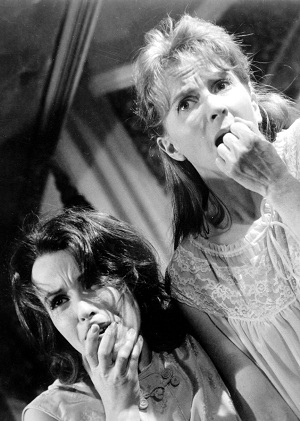
The Haunting review (1963, dir. Robert Wise)

I pray the poor soul chancing upon this despair-smirched scrawl forgives the quality of my record. It has been four nights since last I slept. Frequent opium use has afforded little respite to my fractured sanity. I write in scarlet ink with only the flesh-coloured light of a gibbous moon. When my eyes do close I see only the vague outline of the ‘thing’. Its writhing torso accompanied by mournful ululations and discordant gibbering.


My tale starts with an invitation. A simple letter on the morning mat of an ordinary day. To sojourn in the notorious Hill House. A house born bad. I smirked and discarded the wretched thing there and then. But my old friend Dr Markway was dogged. “An experiment of tremendous important to science,” he persisted. “Vital to the disproval of parapsychological disturbances.”
I humoured him. “I’ll go. But do not expect results. Stuff and nonsense!”

A couple of days later and I ground my Plymouth Fury up the gravel drive. Hill House filled the windscreen, squatting vilely ahead. On entering I greeted Markway and the other lab-rats. I was shown to a grand room and I unpacked before we reconvened for dinner. Luke was brash and cynical, not unlike a gameshow host. Theodora was haughty and mocking in contrast to Eleanor whose demeanour was timid and mouselike. A more diverse group I could not have imagined. Markway knew what he was doing.

Now I am required to still my own hand in order to drive the ink over the page. It vibrates from memory of a primal horror witnessed over those next few nights. The booming reverberations, the gnarled forms, the mutilatedscreams. Onslaughts on reason combined in a fetid rash of terror. I saw, or thought I saw, things that were not meant to be.

And the locus of these events was Eleanor herself. Harried and hunted by a beckoning entity. I collapsed to my knees, shrieking that I could take no more. Without shame I fled, screaming as a babe, to leave the others to what fate had deigned for them.

I heard no more til many years later I learned of a cinematographic reconstruction of the ‘events’. Summoning courage from an untapped seam within, I inserted the ‘DVD’ into my digital-video display construct. My part in proceedings had, perhaps understandably, been excised. And I am convinced some of the events have been reduced in tone and intensity. Nevertheless the film was subtle, refined and rollickingly exciting. The director has employed a devilishly inventive mise-en-scène to suggest much almost without showing anything. A host of perspective tricks and vertiginous moves accentuate the fear. What remains is one of the scariest psychological horror films available to man. See it, if you be brave, and make up your own mind! And please do not confuse with the bastard remake of latter years!

I must go now. The electricity has been switched back on.

23.11.11

Grindhouse Trailer Classics 3 review (DVD, 2011)


If you weren't lucky enough to frequent a certain type of picture-house of the 60s, 70s and early 80s, you've lost your chance to experience the true Grindhouse effect in all its filthy glory.

The next best thing is the Grindhouse Trailer Classics collection!


This feature-length collection of cinematic previews has it all - nudity, ninjas, violence, sexual deviancy, samurai, sadism, exploitation, drug-use and cult favourite, John Saxon! As you'd expect (perhaps even demand), dirt, scratches and clicks blight the video and audio, enhancing the sense of decay and depravity. The colours are as garish and vibrant as they ever were. And the majority are voiced by the instantly recognisable basso profundo of Paul Frees.

Leading your clammy, shaking hand in to this wonderful, lost world is critic and cult-film expert Kim Newman. A gloriously enthusiastic and informed voice in the obscure and esoteric, even Newman is a neophyte to some of the weirdness here. Additionally, his passionate explanation of Grindhouse can be found in the extras section of the disc to help define the experience for the uninitiated.


Nucleus Films have curated a museum of the very strangest previews you will perhaps ever see. To find fault with these trailers on grounds of quality or content would seem a little churlish. These films are no less valid for not being “art-house” or “worthy”. In a lot of these trailers many you'll find a subversive aesthetic missing from most contemporary cinema. In an age when film-makers were pushing boundaries of acceptability, a cinema of fun and excess grew and flourished.

I find an amateurish but passionate film more interesting than a technically perfect, safe piece. What isn't exciting about beautiful Cannibal Girls pick-axing victims to the sound of bells ringing to warn patrons of excessive destruction and eroticism? You'd peek wouldn't you? Superchick may be something of a male fantasy, but isn't an ass-kicking woman more invigorating than a passive, screaming victim? Aren't budgetary constraints the mother of invention? Dogs trained to rob banks? I fear some of these trailers may be superior to the films they are selling!


Admittedly there are some troublesome trailers here for modern sensibilities. A film about the first black CIA recruit tackles racial politics of the time whilst still portraying other black characters as hoods and pimps. Nazi Love Camp 27 risks treating the holocaust as sexual fantasy, though seems to have an admirable budget compared to other films here. And rape seems to be a recurrent narrative device, always used as a prime motivator for revenge and violence on the perpetrator. Whether this in any way excuses its use is up to the viewer.

Grindhouse Trailer Classics 3 is released on December 5th through Nucleus Films. Personal favourites include Linda (possession, nudity, crazy make-up and crabs!), Black Mama/White Mama (inter-racial revenge violence meted out by some of the feistiest women you'll ever meet) and the very curious The Doberman Gang. This extensive and impressive assortment achieves the original intent: to titillate and excite the viewer into seeking out the full feature. Treat yourself to a trip back in celluloid time to a cinema filled to bursting with degradation, sleaze, deviancy and excess. I guarantee there are things here you simply won't experience anywhere else. And that can't be a bad thing.

10.10.11

Red, White & Blue review (2010, dir. Simon Rumley)


Sitting in a darkened room with 15 people, my toes were so curled I could almost kick my kneecaps. Across the room I saw winces, hands across eyes and heads fully turned from the screen. “Oh my…” breathed the woman behind and I wondered who would pass out. They stoically clung on with me, though. We made it through.
The second half of Simon Rumley’s Red, White & Blue kicks your punished psyche into some pretty deep, dark holes. Thankfully your trust is earned with the fascinating drama of the first half. Erica (Amanda Fuller) vacuums by day and vamps by night. In a new bar every night she picks up men with ease, never sleeping with the same one twice. Anyone who gets too close is shunned.
Franki (Marc Senter) is in a band, possibly on the verge of success. They practise rock music in a garage until it’s time for Franki to donate blood to his sick mother. Some of the most heart-rending scenes are between Franki and his mother. That he loves her and wants to help her is never in question.
Nate (Noah Taylor) lives in the same boarding house as Erica. A confessed torturer of animals and CIA operative (or fantasist), Nate tries to break down Erica’s barriers by declaring everything to her. Their initially faltering relationship is frustrated by her indifference. When they do form a bond we witness a profound change in Erica. Cutting up the photo album of her sexual conquests, she finally comes to Nate’s room. They lie together and he makes a crazy suggestion…
Rumley uses a short sequence from one of my favourite films, Carnival of Souls, to signify a turning point. “I’ll never come back,” says Mary. After this moment, none of the characters is able to return to where they were. Then Franki receives terrible news. Something severe enough to change his life, and potentially those of family and friends.
Subsequently there is a rapid descent into one of the very lowest levels of hell, the slow-burn opening giving way to an incendiary denouement. Red, White & Blue is not torture porn. Nor is it gory, sensationalist or cheap. What begins to feel like Dead Man’s Shoes by Shane Meadows or even Death Wish by Michael Winner soon turns into a revenge drama of a different colour. With grim finality it goes beyond revenge into territory occupied by Takashi Miike’s Audition. Most violence is implied. Like the shower scene in Psycho, our eyes see far less than our brains think they saw. Electrifying cuts and distorted bursts of music heighten the anxiety.
Rumley’s film is most certainly a multi-headed beast, uneasily mixing human drama with staggeringly bold nastiness. The sound-design is especially impressive as are the editing and performances. Special mention goes to Sally Jackson as Franki’s mother for a tender, human portrayal of a very ill woman, as well as Amanda Fuller, who makes troubled Erica brave and then vulnerable but never insipid or weak.
Be warned: this film will shock. Yet it’s not your standard horror/revenge fare. Its messages are open to discussion (what is revealed by Nate pushing past the US flags outside Franki’s house? Are the CIA involved in torture? Why does the boy’s mother accept Erica?) but Red, White & Blue has a human heart and is just as beautiful, conflicted and unpredictable as any of us.

31.8.11

Carnival of Souls review (1962, dir. Herk Harvey)


Where do zombies come from? West African and Haitian folklore might be somewhere to start, but I was thinking of the Hollywood zombie, the shambling wretches whose genesis was first witnessed in George Romero’s seminal Night of the Living Dead. They owe a debt, or at least an offering of brains, to Herk Harvey and his only feature length film, Carnival of Souls.
Caked in sodden silt and muddy water, Mary crawls from a river, escaping a car plunged from the bridge above. Staggering dazedly away she appears unable to believe she lived through the accident. Restarting her life, she flees town to find new work as a church organist. Lodging in Salt Lake City, she succumbs to strange ‘episodes’; fading out of existence, invisible to the townsfolk, as all sound drains away. When she eventually slips back into reality, it is obvious something has altered her. Mary has also developed an unhealthy fascination with an abandoned seaside pavilion nearby.
Then a strange man appears at a distance, watching. He is gaunt and pale with black circles around his eyes. Here we witness our first glimpse of the look Romero would appropriate for his zombies. ‘The Man’ is a malignant presence, unseen by others and hounding Mary when she is at her most vulnerable.
More of these haunted entities rise from the ground and the water, pursuing her. As these uncanny forces block her every move, she is driven mad and cornered inside the pavilion itself where she learns her fate.
Carnival of Souls is an undeniably unsettling influence in the history of horror on film but it is far from perfect. There are some shocking instances of amateur acting and ham-fisted scripting. Witness the toe-curling, self-conscious way the local workers stop their work on cue and listen to Mary’s organ playing. Or the heavy-handed irony of the church warden telling Mary she needs to play with more soul.
Then there are performances that add texture to a simple tale. Mr Linden from the neighbouring apartment watches Mary with a voyeuristic gaze. His predatory intrusion represents a real world threat to Mary. Linden contrasts awkwardly with the plainly moralistic folk elsewhere in town. Hiligloss is adequately haughty and haunted as the heroine and carries the film well.
There are flashes of directorial brilliance, such as the transposing of the car dashboard with the knobs on the church organ, or the ghoulish reflection of The Man in the car window at night, a great example of special-effects done on a small budget. And the unforgettable climax with its dancing ghouls pirouetting before the camera. Harvey’s creative talent was possibly nurtured on German Expressionist cinema, as there are touches of Nosferatu’s Count Orlock in the long shadows cast by The Man as he enters the church.
And no appraisal of Carnival of Souls would be complete without mention of the arresting score, composed almost entirely of organ music and played by Gene Moore which accentuates the horror by being unnervingly oppressive.
In the end, Carnival of Souls plays like a short story from a Creepy or Eerie comic-magazine from the 1950s, complete with obligatory O. Henry twist ending. It is at once unforgettably haunting and almost laughably simplistic in its outlook. Yet in this tale the seeds were sown of a cinematic heritage that survives to this day, the modern zombie.
Unfortunately Harvey never made another feature length film and after its release, Carnival of Soulslapsed into obscurity. Rediscovered in the 80s and playing late at night on TV, it found new audiences and continues to this day to exert a freakish power over the viewer.

13.8.11

Twin Peaks: Fire Walk With Me review (1992, dir. David Lynch)


Reviled by many critics and ignored by audiences, Twin Peaks: Fire Walk with Me (1992) has unjustly slipped under many film fans’ radars. Dig below the surface, scrape away years of dirt, and you’ll reveal a rich and multifaceted cinematic gem.
Sitting down to watch TPFWWM again, I am reminded of two things. First: it is one of David Lynch’s finest films as a director, and second: it is one of the greatest horror films ever made, despite the fact it has never been categorised as such and you’ll never find it in the horror section of your local online video download store-hub.
Serving as a prequel to Twin Peaks, the TV series, TPFWWM tells one story that operates on two distinct levels. The film assembles the facts behind the last seven days of Laura Palmer’s life, a high school prom queen played with tortured fatalism by Sheryl Lee. Key to understanding Laura is the revelation of the sexual abuse she suffers at the hands of the mysterious “Bob”.

Overlaid like an acetate cartoon-cell on top of the very everyday town of Twin Peaks, is the supernatural world of The Black Lodge. This is a place outside of conventional space and time whose inhabitants sometimes leave to live in a small room above a convenience store. These entities exist to inflict pain on humankind, the suffering represented by the creamed corn they consume with each soul. They release one of their own, Bob, to possess someone close to Laura with the intention of corrupting her and condemning her to torment in The Black Lodge. An equally valid counter-interpretation is that this is only in the mind of the actual perpetrator of these acts.
Our film opens on a TV screen displaying static. An axe thuds abruptly into the TV as sparks fly and a woman screams. This violently demonstrates that Twin Peaks the TV show is in the Past. Dead. Finished.
In the FBI’s Philadelphia headquarters, David Bowie’s Agent Jeffries appears for a few minutes, after 2 years missing in the field. Jeffries points accusingly at Cooper (a clue to his eventual fate) and proceeds to explain to the assembled agents of his imprisonment in The Black Lodge and the creatures he met there. Jeffries attended one of their meetings to decide the fate of Laura Palmer at the cost of his soul. His tale told, he promptly disappears again.
Meanwhile, in an unfriendly town which appears to be the emotional opposite of Twin Peaks, Agent Chet Desmond, played by Chris Issac, accompanied by Agent Sam Stanley (Kiefer Sutherland channelling Stan Laurel) investigate the murder of Theresa Banks. As Desmond closes in on the otherworldly fate of girls claimed by Bob, he too disappears without trace.
There are several scenes in TPFWWM which are instantly cinematic, unique and bold enough to distance the film from its broadcast heritage. The 10-minute “Pink Room” sequence takes place in a sleazy bar, almost all sound drowned out by pounding, rhythmic music. We can nearly discern snippets of dialogue but the overall effect is exactly the same as trying to hold a drunken, dreamy conversation in a noisy bar or club. The result is hypnotic, unsettling and ultimately leads to one of Laura’s redemptive acts as she saves her friend from a similar fate to her own. (Later DVD releases have subtitles come up at this point, but I know that the original European cinema print has no subtitles and the atmosphere it conjures is all the better for not having them.)
In another powerful scene we encounter Bob in Laura’s bedroom. The intrusion is so unexpected and visceral that we cannot still our hearts from leaping when it comes. Maybe it’s because we don’t expect the standard jumps and scares of a standard horror film here, that we are so taken aback by this.
Lynch has always been a great and unique sound designer. The eerie and omnipresent industrial rumble over Eraserhead springs to mind, or the noise the cadaver makes when moved early on inTPFWWM. When Laura and her father are accosted by a one-armed man on the road into town, his insane screeching and the revving of the car engine combine to drown out the words in a deafening overload of hate and anger.
Yes, you may gain slightly more satisfaction fromTPFWWM if you’ve seen Twin Peaks the series, and for fans of the television show most of the major players do appear in cameos, but as a stand-alone film concerning abuse, incest, loss of identity and the downwards spiral of a confused high-school girl, it is brave and fearless. As a fable about possession and evil inflicted by spirits from another world, an inter-dimensional war between gods centring on a small town and a supernatural horror, it is also triumphant. A game of two halves certainly, but both will chill, disturb and unnerve you more than most so-called horror films out there.

16.6.11

Possession review (1981, dir. Andrzej Zulawski)

It’s seldom a film lunges forward, grabs you roughly by the collar, throws you up against a wall screaming dementedly in your face for nearly two hours. What is Possession? And why will it leave you sprawled and dripping with fetid ooze on your now-desecrated sofa? What happens here to leave you exhausted, razed and slightly closer to the dark and howling abyss of insanity than you were before?


Anna (Isabelle Adjani) and Mark (Sam Neill) bicker and push against each other in their Berlin apartment, as the marriage disintegrates. Symbols of separation are seen in the omnipresent Berlin Wall, frequently seen from their apartment window. Anna ends an affair with Heinrich and begins another. With angry silence from Anna and no leads to uncover her new mystery lover, Mark collapses in a prolonged and bitter, sweaty mess. On regaining his composure (though not necessarily his sanity) he sets out to find Anna’s illicit partner. Questioning the similarly unhinged Heinrich only leads to a beating, while a private detective hired to trail her disappears altogether.

Compounding the queasy puzzle, Anna returns periodically to the flat in various states of anger, anxiety, depression and mania. The blue dress she wears looks more stained and sweat-soaked each time, her hair matted with filth.

Before you think this mystery is the crux of the film, we learn the truth early on and the revelation savagely spins the film around from domestic drama to horror. Anna is in the thrall of a bloody, mucky, tentacled beast she makes love to and kills for. This monstrosity represents the breakdown of the relationship. It is what comes between Anna and Mark but it can’t be defined, is never seen in full, always skulking in shadow and staring malevolently.

Similar themes are explored in Lars Von Trier’sAntichrist, and as a study of failing relationships, madness and body-horror it is hard not to see a direct influence. Possession also recalls the work of H. P. Lovecraft, a writer who explored the intrusion of disturbing, tentacled monsters into everyday life and the consequences on the sanity of anyone witnessing them.

The performances in Possession are brave, edgy and quite theatrical, the whole cast going over the top with glee. The stand-out performance undoubtedly comes from Adjani in her subway miscarriage scene. Walking through the underground station, groceries in hand, Anna starts giggling and grimacing, her eyes bulging crazily. With escalating hysteria her laughs explode into full-blown screams as her body writhes and contorts. The groceries spray across the tiles and she disfigures her face while blood and milk flow from under her dress and across the floor.

An equally macabre scene sees Anna and Mark cutting their bodies with an electric meat carver. Such is the mental anguish of their emotional separation, even slicing their necks and arms provokes no reaction as the blood flows.

Towards the end, as pieces unravel, the story takes oblique twists and turns. The son’s school teacher appears as a doppelgänger of Anna, raising questions of identity. Heinrich’s mother turns out to know more about what is going on than it seems. This will require multiple viewings to be understood.

Possession has only recently been scooped up and slopped in a quivering mass onto DVD in the UK after its incorrect labelling as a video-nasty in the ’80s. Watch the film and you realise it eludes genre classification altogether. The horror aspects are brief and often comical, and the creature itself, while disgusting, is only glimpsed briefly. Possession‘s over-riding theme is the portrayal of the banally traumatic process of divorce. Zulawski drew heavily on his own experiences to reach deep into his soul and spew forth the bitter and rank contents into this film. It’s about the grinding down of a relationship between people descending into derangement which ultimately results in their own loss of identity. I have an unashamed and rather dirty love for Possession and I only hope you search whatever dank corners you need to find a copy for yourself.

29.4.11

Bug review (2006, dir. William Friedkin)


Can swallowing too much toothpaste send you insane? Or the aluminium in your underarm deodorant? Your mobile phone signal can definitely fry your brain. I am pretty sure some people go crazy from the Wi-fi in their homes. Then there's the mind-control-beams. The ones the government fire at our twitching, fearful, bodies at night. And the bugs!

The modern world could send you spiralling into insanity if you think about it too much; an idea that lies at the heart of Bug.

Agnes is bored, lonely and poor but she is also free after escaping an abusive marriage. She stands on the porch of her motel room, works nights at a lesbian bar, and doesn't do a lot in between. Pete appears after an innocuous introduction and he seems interested in her. Agnes resignedly lets him in to her life. He doesn't leave and they live together at the motel by default.

Pete (Michael Shannon) gradually infects Agnes (Ashley Judd) with the notion that bugs are everywhere in her home. It's a disease that Pete has been carrying, ready to unleash on a vulnerable mind. By the time we realise he is paranoid and delusional, Agnes is already snared. Using either luck or design he has entered her life at exactly the right time to get “under her skin”.

Pete sees the bugs everywhere. Insects sent by the government to spy and control us. Insidious bugs that we can't see, but we know they are there because he tells us. Through a creepily charismatic performance he drags her into his madness. Orbiting around them are Agnes's best friend, her ex-husband and someone who may or may not be “looking after” Pete. But this film is essentially a two-hander that can distilled down to the log-line; “a couple go crazy in a motel room”.

It escalates and then, at the end, it escalates again. To say more would spoil it, but plenty of tin-foil and fly paper is involved.

The limited sets and the small cast give it the air of a stage play, and this is no surprise given it was originally written for theatre by Tracy Letts. This economy of scale contributes to the claustrophobia. You can feel that Agnes's life is rapidly imploding. In no time the couple have cut themselves off from the “normal” world, retreating into the confines of the motel room.

What impresses is that this film has two central performances that will keep you mesmerised and that it's overseen by a veteran director who keeps it feverish and unexpected. It has all the bravado and edginess of a first-time director. A director who hasn't been trampled by the studio system yet. It's exciting to see Ashley Judd deliver as intense a performance as this. Michael Shannon brings a probing, uncomfortable, stare and a set of mannerisms that are eerily effective. The director is clever enough to keep this character simmering on just the right side of socially acceptable. When Pete has to show his true nature, Shannon steps up and gives a devilishly manic turn.

William Friedkin has shocked and thrilled before with a diverse resume that includes The Exorcist, The French Connection, To Live and Die in L.A. and Cruising. For critics he may have reached a creative peak in the 1970's and early 1980's, but in Bug he shows that is assessment is not accurate. This film delivers all of the passion and emotion we saw in earlier works.

There may be no strong authorial stamp on most of Friedkin's films but they do share an energy, a bravery and a love of putting human beings through physical and metaphysical extremes. This seems to be a common thread that connects them. Bug is no different. Amongst the body horror and delusion there's points to be made about moral panics in the media, social alienation, diagnosis of mental illness and the culture of conspiracy theory.

A film about paranoia and loneliness that has the power to make you feel dirty and disorientated.