27.3.12

Jo Nesbo's Headhunters (Hodejegerne) review (2012, dir. Morten Tyldum)

Comfortably replete with Jarlsberg Cheese, Vikingfjord Vodka and some wonderful Scandinavian pastries you could be forgiven for thinking I'd forgotten I was here to review a film. But this was just the very genial introduction to a new Norwegian film hitting UK shores in April.


I settled, satisfied, into my seat for what I expected from the trailer to be a straightforward, nuts and bolts thriller but Headhunters is much more than that. It is a surprising and hilariously tricksy film with a darkly comic and quite sadistic inner-core.

Roger Brown (Aksel Hennie) has all the trappings of a respectable businessman, complete with smart car, suits, wife and house. His snappy moves have earned him a role as a man for head-hunting the best corporate talent. Only his diminutive stature provides any level of self-doubt. However, his life is a minutely assembled and shock-proofed lie, as it transpires his fortune is amassed almost entirely from art-theft.

At a party he is introduced to the suave Clas Greve (Nikolaj Coster-Waldau, known to US/UK audiences from Game of Thrones). Roger spots an opportunity to end his criminal career with the biggest theft of all, the valuable Ruebens painting at Clas's apartment. His accomplice, Ove, will sneak the painting out of the country and onto the black market.


On executing the plan things go disastrously awry. What appeared to be a simple art heist leads to questions about Roger's wife's fidelity. Then the story becomes a chase across the Norwegian country-side as Roger evades a relentless assassin. As he runs, the tension, set-pieces and improbability escalate. Traps and schemes become ever more inventive and no one can be trusted. Headhunters evolves into something wild and unpredictable. Escapades involving skewered dogs, errant tractors, a large amount of faecal matter and flying cars are some of the obstacles added to the delirious brew.

Headhunters won't set the world alight in terms of acting, direction or artistry but for 98 minutes you will laugh, wince and tremble as our hero, Roger, is wrung through the wringer and then wrung again through an ever more twisted set of wringers, each wringer more cruel and twisted than the last. A tense, hilarious and evil viewing experience which will keep you guessing.

Headhunters is released in the UK and Ireland on April 6th. Find the trailer here.

12.3.12

A Horrible Way To Die review (2010, dir. Adam Wingard)


Adam Wingard's 2010 film stands as an impressive achievement. Intense performances; a restrained and understated script and a twisted, thrilling tale. But undermining all of this, a few creative decisions threaten to derail the film entirely. Does what remains withstand this onslaught? Is the powerful substance more than the alienating style?

Set in Midwestern America the film is a taut horror/thriller concerning a recovering alcoholic coming to terms with a past relationship which was not what it seemed. At an alcoholic support-group, Sarah (Amy Seimetz) meets fellow troubled-soul Kevin (Joe Swanberg) who asks for a date. Meanwhile her ex-boyfriend, serial-killer Garrick (A J Bowen), has violently absconded from gaol and is making a viscera-strewn path back home.


Sarah's relationship and drinking are going well and it appears she has turned her life around. Then her past collides with her present in a wholly unexpected way. What follows presents us with a unique and daring twist on the serial killer genre. Past and present are melded without confusion as we observe first hand how Sarah and Garrick once shared a loving relationship.

And all of this would make for a simply-told, solid film were it not for the directorial style. Shot entirely with a constantly swaying, hand-held camera, even the most motion-sick resistant will find themselves challenged not to succumb to giddy nausea. The lens never looks like it is more than a few centimetres from the actors faces. The depth of field is so shallow background detail is lost in a blurred haze. Establishing shots are few, landscapes are non-existent and no opportunity is missed to de-focus or pan away from the action. This is a great shame because such a self-conscious attempt at disorientating the viewer detracts from the naturalistic performances.


If you think you can maintain your concentration through these distancing techniques then A Horrible Way To Die is an un-sensationalist story with a shocking twist. Just don't expect to walk away without a certain amount of vertigo.

Released on DVD and Blu-ray in the UK on March 19th.

5.2.12

The Woman in Black review (2012, dir. James Watkins)

Daniel Radcliffe bears the weight of The Woman in Black almost solely on his shoulders. Despite being a recent alumnus of Hogwarts it's perhaps too large a burden. The central portion of the film has Radcliffe (as lawyer, Arthur Kipps) alone in a dilapidated house of hell. There is little to do but observe and react. When he's required to interact, with the formidable supporting cast, his weaknesses are more apparent. Not least that he looks just a smidgen too young to be a recently bereaved father and a trained lawyer.


Dispatched to settle the affairs of a recently deceased woman, Kipps arrives in a quaint but markedly rude village in the heart of the Victorian countryside where, beneath its chocolate-box veneer, dark undercurrents flow swiftly. No one wants to talk,. Kipps is warned to stay away, and the children are confined to their homes.

A high rate of infant mortality stalks the frightened streets and hushed voices speak of a vengeful spirit connected to the property of the dead woman. An apparition of a black-clad woman is said to lead youngsters away to their death. Nearby an abandoned house casts a deathly shadow over the place. The house lies across a narrow, sodden causeway precariously crossing the marsh. The path is covered cut off by the tide for several hours a day, effectively trapping visitors there should they visit at the wrong time.

The only friendly face in the village belongs to Daily (A sombre Ciaran Hinds) father grieving over the loss of his boy. Daily drives Kipps across the marsh to the house but doesn't hold with any of this “superstition nonsense”. As a lone voice of reason and science in the village he is severely outnumbered.

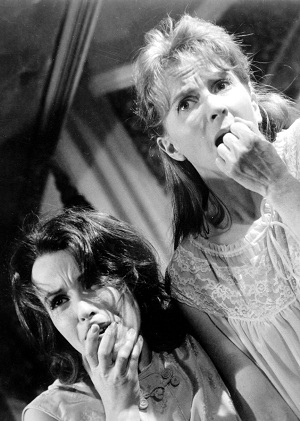
Writer Jane Goldman has treated the original novel by Suan Hill as a template, maintaining the bones of the plot and the sense of dread. The Woman in Black is most effective when Kipps is alone in the house, sorting through paperwork. As he works he starts to hear noises, see things in his periphery. Something is with him. Tension is carefully built as he investigates. One sequence calls to mind the 1963 film The Haunting, when. A reverberating, bassy thumping emanates from behind a locked door, ramping up the tension. And the house itself could be a twin of Hill House from that film.

Director James Watkins (director of “Broken Britain” parable Eden Lake and writer of the curious My Little Eye) paces the scares in well-timed ebbs and flows, maintaining a strong sense of foreboding. An accomplished cast bring a touch of class to a tale with little ambition other than to creep under the skin of the audience. A few well-worn tropes serve to distance the seasoned film-viewer: wind-up toys springing to clock-sprung life of their own accord; gaudy, glassy-eyed Victorian dolls observing all, and words etched in blood spewed across the walls. There is a small nod to the debate about the supernatural versus enlightenment but it is soon abandoned when the source of the terror is revealed.

The good news is that The Woman in Black does what a film under the Hammer productions banner is expected to. It provides a roller-coaster of thrills and jumps, some cheesy and some downright scary, while remaining largely free of computer generated imagery. The finale is a little wrought and sentimental, though not enough to derail what has gone before. There are moments of silliness and some straining of credibility in the effort to scare the audience. But, give in to it, leave your cynicism at home, and the hairs on the back of your neck will stand proud. You'll laugh with relief that you survived the next big “BOO!” and grab the hand of your partner. Isn't that what you want from a horror film?

UK general release: February 10th

21.1.12

The Haunting review (1963, dir. Robert Wise)

I pray the poor soul chancing upon this despair-smirched scrawl forgives the quality of my record. It has been four nights since last I slept. Frequent opium use has afforded little respite to my fractured sanity. I write in scarlet ink with only the flesh-coloured light of a gibbous moon. When my eyes do close I see only the vague outline of the ‘thing’. Its writhing torso accompanied by mournful ululations and discordant gibbering.


My tale starts with an invitation. A simple letter on the morning mat of an ordinary day. To sojourn in the notorious Hill House. A house born bad. I smirked and discarded the wretched thing there and then. But my old friend Dr Markway was dogged. “An experiment of tremendous important to science,” he persisted. “Vital to the disproval of parapsychological disturbances.”
I humoured him. “I’ll go. But do not expect results. Stuff and nonsense!”

A couple of days later and I ground my Plymouth Fury up the gravel drive. Hill House filled the windscreen, squatting vilely ahead. On entering I greeted Markway and the other lab-rats. I was shown to a grand room and I unpacked before we reconvened for dinner. Luke was brash and cynical, not unlike a gameshow host. Theodora was haughty and mocking in contrast to Eleanor whose demeanour was timid and mouselike. A more diverse group I could not have imagined. Markway knew what he was doing.

Now I am required to still my own hand in order to drive the ink over the page. It vibrates from memory of a primal horror witnessed over those next few nights. The booming reverberations, the gnarled forms, the mutilatedscreams. Onslaughts on reason combined in a fetid rash of terror. I saw, or thought I saw, things that were not meant to be.

And the locus of these events was Eleanor herself. Harried and hunted by a beckoning entity. I collapsed to my knees, shrieking that I could take no more. Without shame I fled, screaming as a babe, to leave the others to what fate had deigned for them.

I heard no more til many years later I learned of a cinematographic reconstruction of the ‘events’. Summoning courage from an untapped seam within, I inserted the ‘DVD’ into my digital-video display construct. My part in proceedings had, perhaps understandably, been excised. And I am convinced some of the events have been reduced in tone and intensity. Nevertheless the film was subtle, refined and rollickingly exciting. The director has employed a devilishly inventive mise-en-scène to suggest much almost without showing anything. A host of perspective tricks and vertiginous moves accentuate the fear. What remains is one of the scariest psychological horror films available to man. See it, if you be brave, and make up your own mind! And please do not confuse with the bastard remake of latter years!

I must go now. The electricity has been switched back on.

3.1.12

The Notorious Bettie Page

“I never thought it was shameful. It felt normal. It’s just that it was much better than pounding a typewriter eight hours a day.”


Thwack! Ow! Thwack! Ow! Thwack…! Ooh…! I’m really hammering the hell out of my keyboard. Hmm, that reminds me of something…

Bettie Mae Page made the most sordid of acts fun and wholesome. With her capacious smile and twinkling eyes, you believed she was relishing paddling the hell out of another woman’s bottom. Equally comfortable dressed in black lingerie while gagged and tied, her lolling stare challenged the viewer to find anything wrong with the image. Pornography focused on the male gaze is notoriously humour-free and po-faced; Bettie Page brought a sense of cheeky fun, dispelling the notion that she wasn’t enjoying herself too. Or possibly she saw it for how silly it all was. Sporting a distinctive, and much imitated, short fringe and jet-black hair, Bettie was renowned for glamour modelling and fetish photographs of bondage, whipping, spanking and domination during the 1950s. Bettie was also a devout Christian.

Finding success first in a fledgling Playboy magazine as Miss January 1955, Bettie’s iconic Christmas picture characterised her lack of inhibition. This image came in the middle of Bettie’s heyday as a sadomasochistic model for the brother and sister team Irving and Paula Klaw. Paula took the bulk of these images, and Irving sold them through mail order to fetish fans. Avoiding censorship by not actually featuring any pornographic or nude material, Klaw’s images featured titillating and cheesy scenes of restraint and punishment.

The FBI destroyed Klaw’s business on grounds of deviancy, using him as an example to deter others. By the turn of the 60s, Bettie’s modelling career ended and as she started attending regular Bible classes she withdrew from show business. Treatment for acute schizophrenia followed. After attacking a landlady, she was sentenced to a prison term of eight years. She didn’t know it herself, but the 80s marked an era of revival for Bettie Page with books, comics and films resurfacing to be avariciously consumed by new fans fascinated by her natural ease in front of the camera.

As Bettie-mania intensified and she learned of her new-found fame, she never allowed herself to be photographed or interviewed, preferring to be remembered as she was in the 50s. In a rare interview by the magazine that made her famous, Bettie stated that modelling had been preferable to pounding a typewriter every day. Her death from heart attack in 2008 came after years hiding from the spotlight. Her headstone reads ‘Queen of Pin-Ups’.


The Notorious Bettie Page (2005), is a curiously restrained and empty affair (no pun intended. No, make that pun intended). With the more intimate feel of a made-for-television biography and treating almost everyone as essentially innocent, it resembles Bettie’s own world view. Even a sexual assault in her college life does little to dampen her spirt. Gretchen Mol sparkles as she consumes herself with the character. The trouble is there is no flesh on the Bettie myth. Despite the film’s mission statement to tell you all about Bettie, she remains as elusive as she did in her years of hiding. And with no explanation for why she spent years playing at being tied and abused, the film portrays her as a naïve airhead. Even her later born-again Christianity is given little dissection and she becomes a catalyst for events without motive or reason. Director Mary Harron brings little visual flair aside from the innate detail of the period costumes, sets and monochrome photography.

The great interest of the film lies in the examination of 50s attitudes to pornography in the US and how they stand up compared to today. It’s obvious we’ve travelled a long road for ill or not. The longevity of Bettie’s appeal represents nostalgia not for a time before overt filth and depravity, but a desire to return to when it was (allegedly) more innocent and fun. The idiosyncratic twinkle in Bettie’s eye, unique styling and faux-naughty grin are all symbols of this golden age of good, honest, healthy perversity.

21.12.11

My 10 Favourite Films of 2011

In no particular order:


Tree of Life (dir. Terrence Malik)


Cinema, in part, is life writ large. Terrence Malik's masterpiece is life writ bloody humungous. Like an over-inflated sense of one's own awsomeness. Soft and tender, like the downy hairs on a frowning woman's face and floatily sensual like a helium-engorged silver cats head. Try and find it silly and pretentious and it will turn around and groggily hug the very softest membranes of your inner organs. Literally all of life is here, and it's a gossamer fist slid through a star-filled tube of gas. Why wouldn't you love it? It loves you.


A Separation (dir. Asghar Farhadi)


This isn't bad, trite, ill-observed, weak, emotionless, with nothing to say about people, Iran, the middle classes, working classes or religion. In fact it's the opposite. I hope my tone is conveying how good it is. Ha-ha. Now I'm grabbing you by the lapels and saying how wonderfully acted it is. Ha-ha. Now I'm shaking you. Perhaps you should see it.


Tinker Tailor Soldier Spy (dir. Tomas Alfredson)


A fuggy, hand-rolled mix of elegant wallaper, age-aware-agents and unspoken irrelevant malice. Like breaking into an apartment untouched since the 70s to be told 'things are changing' by a group of immaculately dressed, highly intelligent, very sad, betrayed ghosts.


Of Gods & Men (dir. Xavier Beauvois)


Tremendous trapped trappists. This film is so much more than those 3, awesomely unimaginative words. Elegiac, haunting, loving and spiritual in a way that has nothing to do with those simpering, essential-oil burning, kaftan-wearing freaks who infect the very earth we walk on. The best use of music in a film this year.


True Grit (dir. Ethan CoenJoel Coen)


At this stage, the Coen Brothers don't care what you think. They just want to make a movie. As if by accident this one chimes with you. They complete you. A Western.


Submarine (dir. Richard Ayoade)


To a one-time insufferable, self-obsessed young adult whose belief that they are the centre of the universe over-rides their concern for others, I can jive with this joint. Its funny, different, confused and lovingly done. The film in my head is happy to include a reference to this film in a script that doesn't even fucking exist yet!


Green Lantern (dir. Martin Campbell)


A comic-book movie that acts and behaves like a comic-book movie. Funny, thrilling wish-fulfilment fantasy which speaks to anyone who ever just wished a purple chap would turn up and say "You are special. I'm making you a super-hero".  Just think! You would want that!!


Black Swan (dir. Darren Aronofsky)


If you're making a psychodrama, make sure you add a healthy, talking-apes-worth of psycho with that drama. What would happen if you took random snippets of everything written on Linkedin and then diffused them with a common-or-garden hand-spray onto a film about losing oneself. Then make it more-so. With an unhappy frown. And a mirror made crack'd with a sprinkle of mental. Dressed as a prettier version of a duck.


Senna (dir. Asif Kapadia)


Formula 1's greatest driver. If you like people who are far more talented than you will ever be in your miserable, fetid, bed-sitted life, you will like this. If you don't, you will like this. If you like Formula 1 then a petrol-fumed icing has just been applied liberally to what you call "my cake".


and finally a bit of TV derived from film...
This is England '88


Just like the film of the same name minus the 88 and This Is England 86, this is a drama with characters in. And by characters I mean real people on your vid-screen. And like in real life almost everyone is, at heart, benevolent, funny, thinking, breathing, sweating, copulating and being. Every line is delivered like words spoken from a mouth, every image make mundanity achingly pretty. The best drama on a TV. 

1.12.11

After Hours review (1985, dir. Martin Scorsese)


When did you last find yourself trapped somewhere on a night out? A tragic victim to fate when a potential encounter turned out to be something else or a wrong turn led to unheralded possibilities? I’ve more than once found myself wandering rain-washed streets long after the last train has rattled down the tracks of circumstance. I’ve no doubt neon signs reflected in pools of oily rain-water were involved too.

And that’s why I love After Hours.


A twisted, tormented trip through the dark streets of down-town Manhattan awaits Paul Hackett (Griffin Dunne) reminding us that hell can often be found on earth. The bare bones of this modern fable bring to mind Dante’s epic poem ‘Inferno’. Every time Paul escapes from one circle of tortured souls, he seems only to fall into another. Compounding his agony are characters who resurface only at the worst times to hound him and push him further into the depths. Franz Kafka is frequently referenced by the screenplay – in the book Paul reads, and in some of the dialogue which is lifted in whole sentences from Kafka’s writing. Writer Joseph Minion draws parallels with the anguish in the face of absurdity which characterizes Kafka’s stories.

After Hours can also be read as an emulation of Carroll’s Alice in Wonderland. A simple object, a ‘plaster-of-paris cream-cheese-bagel paperweight’ in this case, stands in for the White Rabbit, leading the protagonist down The Rabbit Hole into a dreamscape menagerie of weird creatures. Those who seem at first to be friends turn on the merest whim, while even an innocent request can be misconstrued by a paranoid brain. After Hours is New York. A collection of differing – dare I say ‘kooky’? – types thrown together in a confined space, rubbing up against each other with often explosive results.


It takes place over the space of a single night. Paul tries to pick up Marcy (Rosanna Arquette) in a coffee bar. Taking her number, his libido forces him to call right away on the pretence of collecting one of her roommate’s paperweights. He calls her and, after a strained conversation, travels to Soho in a taxi, losing all his money through the cab window. Paul is ensnared, unable to return home without a fare, frustratedly unable to progress his relationship with Marcy (has he misread the signals? Is she deeply scarred physically and emotionally?) and at the mercy of fate.

After Hours features some of my favourite US actors, including a perky turn from Terri Garr, a benevolent John Heard, a giddy Catherine O’Hara, stoner comedians Cheech & Chong and a hysterically disturbed turn from Rosanna Arquette. Other familiar faces turn up as bondage artistes, criminal low lives, punk clubbers and misunderstood gay men. Vertiginous camera moves and nervy acting from Griffin Dunne help propel a fast-paced narrative.


Watch After Hours in conjunction with King of Comedy as an exploration of Scorsese’s black comedy oeuvre. Stylistically this certainly feels like the same New York as Taxi Driver. Or show the film to someone as a historical lesson on what a night out was like before the ubiquity of cash machines and mobile phones. For anyone who remembers those ‘dark ages’ it will strike chord and possibly make one yearn for a time when it was possible to be truly alone in a city.